BMW AC Compressor Failure
You’ve probably never thought about your BMW’s AC compressor. There’s no reason to, until the day the air conditioning stops blowing cold and someone tells you that’s the part responsible.
Now there’s a component name you don’t recognise in the conversation, and a repair you hadn’t budgeted for…
The AC was working the last time you used it. So what went wrong?
That’s the frustrating part. Compressor faults don’t always announce themselves with an obvious noise or a dashboard warning. Sometimes the first sign is warm air from the vents on a day when you actually need the AC to work.
You’ve probably already tried a regas. It didn’t help. And now you’re wondering whether this is a big job, whether any garage can do it, and how long you’ve been driving around with the problem without knowing.
None of those questions has a clear answer without a full look at the system.
That’s what this guide is for. We’re covering BMW AC compressor failure in detail, focusing on the electromagnetic clutch type fitted to many BMW models, including the 3 Series, 5 Series, and X5 from around 2016 onwards.
If you’re not sure which compressor type your BMW has, a specialist can confirm it for you.
Your BMW’s AC compressor circulates the refrigerant that cools your cabin. It is driven by an electromagnetic clutch connected to the engine’s belt. When that clutch wears out or fails, the compressor stops engaging, and the air conditioning blows warm. You may also notice sounds from the engine bay when the AC is switched on. Specialist repair work is needed.
So what’s actually going on inside the system?
How Your BMW’s AC Compressor Creates Cold Air
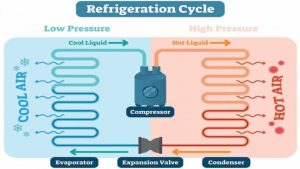
Everything your BMW’s air conditioning does begins with pressure. The compressor, sitting at the centre of a closed-loop refrigerant circuit, is what generates it. Its function is to draw in low-pressure refrigerant gas and compress it to high pressure.
That change in pressure is what forces the refrigerant to move through the rest of the circuit.
After the compressor has done its job, each component in the system handles a specific step:
- At the front of the vehicle, the condenser draws heat from the pressurised gas until it condenses into a liquid.
- The expansion valve then rapidly reduces the pressure.
- Finally, the evaporator absorbs warmth from the cabin air, delivering the cooled air through your vents.
If the compressor isn’t working, the entire process stalls. Meaning the refrigerant isn’t moving, the system can’t cool, and you get warm air.
Not every BMW uses the same compressor design. Some models use a variable-displacement type that runs continuously and adjusts its output rather than switching on and off.
Others use an electromagnetic clutch that physically connects and disconnects the compressor from the engine’s auxiliary belt.
A specialist can confirm which type of BMW AC compressor you have.
The Electromagnetic Clutch: What Connects Your BMW’s Compressor to the Engine
Look at the front of your BMW’s engine, and you’ll find the compressor, connected to the auxiliary belt. While the engine runs, that belt keeps a pulley on the compressor spinning continuously, but the compressor isn’t doing any work at this stage. The pulley turns freely on its own bearing, separate from the compressor’s internal mechanism.
The electromagnetic clutch is the link between the two.
When the climate control system decides the cabin needs cooling, it sends a signal to the clutch coil. A magnetic field generated by the coil pulls a pressure plate tight against the rotating pulley. The compressor shaft and pulley become one, and the refrigerant starts to flow.
Once the target temperature is reached and cooling is no longer required, the coil powers down, the pressure plate springs away, and the compressor stops. The pulley continues turning on its bearing, ready to engage again when the next call for cooling comes.
Every engagement cycle puts wear on the clutch.
The electromagnetic coil, the pressure plate, and the pulley bearing all accumulate fatigue over thousands of on-off cycles. Any one of those parts can eventually fail, whether the clutch refuses to engage, slips intermittently, or develops an electrical fault.
So what does it look and sound like when the clutch gives up?
Recognising the Symptoms When Your BMW AC Compressor Fails
The symptoms of BMW AC compressor failure vary depending on what’s actually gone wrong inside the unit. Some failures are completely silent. Others produce noises that are difficult to ignore. Common patterns include:
- No cold air, no obvious cause: You switch the AC on, and the air from the vents stays warm. No noise, no warning light, nothing to indicate a problem except the lack of cooling. This can suggest a BMW AC compressor not engaging, often because a part within the clutch has worn out or lost its electrical connection.
- A grinding or squealing noise when the AC is on: If there’s a sound from the engine bay that appears when you switch the air conditioning on and disappears when you turn it off, that’s worth noting. A worn bearing on the compressor pulley is a frequent source of BMW air conditioning compressor noise, and it tends to worsen.
- Cooling that fades in and out: The AC blows cold for a while, then drops off, then returns. This pattern can point to a clutch that’s engaging but can no longer maintain its grip under load. It’s likely to get worse over time rather than resolve on its own.
These are common patterns, but other faults within the AC system can produce similar effects. A thorough technical evaluation is the only way to pin down exactly what’s happening.
If your BMW air conditioning stopped working the way it should, or there’s a BMW air conditioning compressor noise you haven’t heard before, it’s worth having it checked. Speak to our team at Quality Car Service, Milton Keynes, and we can walk you through what’s involved.
Why a Regas Won’t Help If Your BMW’s Compressor Has Failed
The first instinct for most BMW owners when the AC goes warm is to book a regas. In some situations, that’s all it takes. But if the compressor itself has failed or the electromagnetic clutch isn’t engaging, adding more refrigerant won’t change anything.
There’s no mechanism to circulate it.
The compressor needs to be operational before a regas has any effect. If the clutch isn’t pulling the compressor in, the refrigerant sits idle in the system. If the compressor is turning but is damaged internally, it can’t generate enough pressure to produce cold air. Either way, the refrigerant goes to waste.
And that waste isn’t cheap.
BMW models from 2016 onwards use R1234yf refrigerant, which is significantly more expensive than the older R134a. A regas on a system with a failed compressor means paying for refrigerant that does nothing.
Compressor faults tend to creep in over time, and many BMW owners don’t notice because they aren’t demanding cold air from the AC during the cooler months. While the system may still operate in the background for demisting, the lack of cold air demand means a deteriorating compressor often goes unnoticed.
The fault only reveals itself when warmer weather arrives, and the AC is needed for cooling. By then, the clutch or bearing may have been wearing for months.
If you’ve had a regas and the air conditioning still isn’t cold, that’s a strong sign the problem sits elsewhere. BMW AC compressor failure is one of the more common explanations when a regas makes no difference.
What Makes the BMW AC Compressor Repair Work a Specialist Job?

Refrigerant work on a BMW air conditioning system is legally regulated. The technician must hold a specific handling qualification, and the equipment must meet defined standards. Not every workshop has either.
Current BMW models use R1234yf refrigerant, and the recovery, recycling, and recharging process requires dedicated equipment with fittings that differ from those used in older R134a systems.
Refrigerant quantities have to be precise. Getting this wrong doesn’t just mean the AC won’t cool; it can lead to further damage within the system.
When our technicians at Quality Car Service, Milton Keynes, carry out a BMW air conditioning assessment, we begin with a thorough technical evaluation to identify what’s actually failed before recommending any work.
Our team has the qualifications, the experience, and the correct tooling to work on your BMW’s refrigerant system safely and to manufacturer standards. You’ll know exactly what needs doing before any work goes ahead.
If your BMW air conditioning stopped working, or if something doesn’t sound right when the AC kicks in, speak to us on 01908 376555. We’ll give you an honest answer.
BMW Air Conditioning Repairs in Milton Keynes: Why Choose Quality Car Service?
BMW AC compressor failure calls for a garage with the right qualifications, the correct tooling, and the experts with the experience to get it right the first time. At Quality Car Service, Milton Keynes, our technicians have all three.
Here’s why Milton Keynes drivers choose Quality Car Service for BMW air conditioning work:
- Qualified technicians with the required refrigerant handling certification for current BMW AC systems
- Access to dealer-level technical information and equipment for accurate fault identification and repair
- All work is backed by a 12-month parts and labour guarantee
- A courtesy car is available while your BMW is with us
- Clear, upfront pricing; you’ll know what’s needed before work begins
Join the other local Milton Keynes drivers who’ve rated us {{average-rating}} across {{review-count}} reviews for accurate repairs, clear communication, and better value than the dealership.
If your BMW’s air conditioning isn’t performing as it should, we’d rather you knew why. Ring us on 01908 376555, and we’ll talk it through with you.
Your BMW AC Compressor Questions Answered
Can any garage legally replace a BMW AC compressor?
Not all UK garages can. Any work on the refrigerant side of a BMW air conditioning system requires a technician with specific refrigerant-handling qualifications and dedicated recovery and recharging equipment. At Quality Car Service, Milton Keynes, our technicians hold the required qualification and have the correct tooling to carry out this work to the standard your BMW needs.
How do I know whether my BMW needs a compressor replacement or a regas?
If the compressor or its electromagnetic clutch has failed, a regas won’t restore cold air. Look out for warm air with no change when the AC is selected, a BMW AC compressor not engaging, or cooling that comes and goes. Other faults can cause similar symptoms, so a technical evaluation is the only way to confirm. Speak to Quality Car Service on 01908 376555, and we can talk it through.
Why has my BMW’s AC stopped working even though I haven’t used it all winter?
Compressor faults often build up gradually. During the cooler months, you’re unlikely to notice because you aren’t relying on cold air. While the AC may still run for demisting, a failing compressor goes undetected until warmer weather arrives and you need cooling again. Lack of use can also cause components such as the clutch or seals to deteriorate. If it’s only just become apparent, get in touch with Quality Car Service on 01908 376555, and we’ll let you know what’s going on.
What wears out inside a BMW AC compressor’s electromagnetic clutch?
The clutch engages and disengages every time your air conditioning cycles. Over thousands of repetitions, the electromagnetic coil, pressure plate, or pulley bearing can wear down. The clutch may fail to engage, overheat, or develop an electrical fault. A technical evaluation will confirm which part has failed and what needs to happen next.