VW Intake Valve Carbon Buildup
Your VW Golf GTI used to pull with purpose. Every press of the throttle felt immediate, every overtake confident and controlled.
Then something shifted…
The idle feels uneven on cold mornings. The acceleration that once felt razor-sharp now feels flat. And there’s no warning light on the dashboard to explain it.
That last part is what catches most owners off guard. When a car loses performance gradually, with no dashboard alert, it’s easy to assume it’s just wear and tear. It isn’t.
VW Golf and Tiguan models with the 2.0 TSI direct injection engine can develop VW intake valve carbon buildup over time. Because fuel enters the combustion chamber directly, it never passes over the intake valves. Oil vapour from the engine’s ventilation system settles on the valve surfaces, hardens with heat, and gradually restricts airflow into the cylinders.
So what does that mean for your engine?
In this guide, we’ll walk through why VW Golf GTI carbon buildup develops on TSI engines, what the symptoms look like, which models are most affected, and how the right specialist can clean it up and bring that edge back.
What Makes Direct Injection Different on a VW TSI Engine?
The reason carbon builds up on your intake valves comes down to how your engine handles fuel.
On older petrol engines, fuel was delivered into the intake manifold. It flowed past the intake valves before reaching the cylinder, and the detergent in the fuel kept those valve surfaces clean as a by-product of normal operation.
The TSI engine in your VW works on a different principle. Fuel is injected straight into the cylinder under high pressure, without passing over the intake valves at all. VW designed it this way deliberately.
Delivering fuel directly into the cylinder gives the engine greater control over how much fuel is used and when it burns. That precision is one of the reasons your Golf GTI or Tiguan responds the way it does.
The trade-off?
Without fuel flowing over them, the intake valves lose their natural cleaning mechanism. Air still moves through the intake, but there’s nothing to prevent oil vapour from settling on those valve surfaces. Over tens of thousands of miles, that absence has real consequences.
Why Do Carbon Deposits Form on VW TSI Intake Valves?
Every time your engine runs, a small amount of oil vapour is produced. That’s normal. The engine’s ventilation system routes this vapour back into the intake, where it’s drawn in and burned as part of the combustion cycle. On engines with port injection, fuel flowing over the intake valves helps prevent this vapour from settling.
On a VW TSI engine, the fuel goes straight into the combustion chamber. It never touches the intake valves. So when oil vapour reaches the back of those valves, nothing washes it away.
That’s where the problem begins.
Heat from the engine hardens those deposits into a thick layer of carbon that builds gradually, layer after layer, over tens of thousands of miles. As the buildup thickens, it starts to restrict airflow into the cylinders. Less airflow means the engine can’t burn fuel as well, and that’s when carbon buildup on the intake valves starts affecting how your car drives.
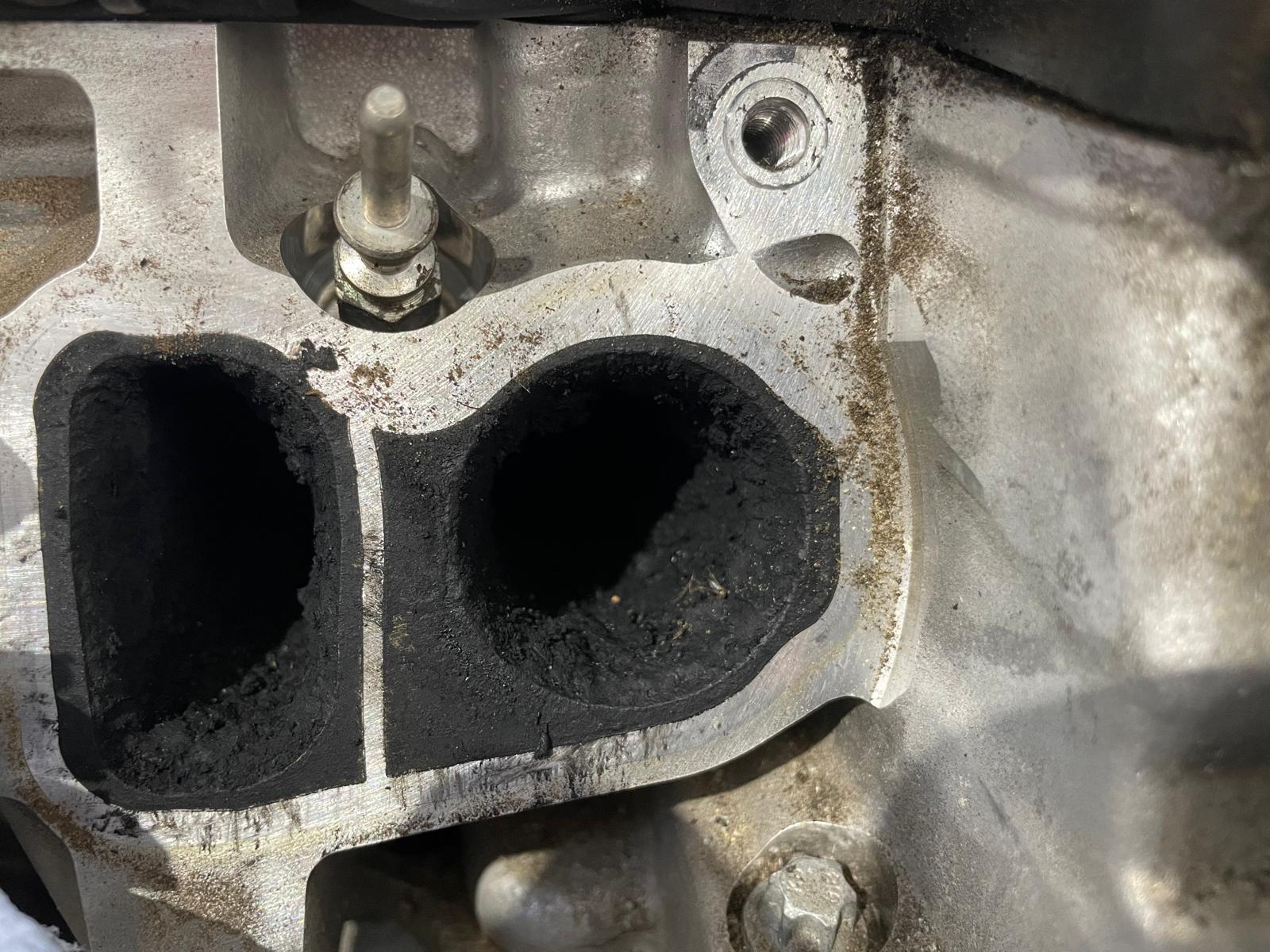
Carbon deposits accumulating inside the intake ports can restrict airflow and affect engine performance
What VW Golf Carbon Buildup Symptoms Feel Like
The signs of carbon buildup develop over time, not all at once. Because the change is so gradual, it’s easy to put it down to wear and tear rather than a specific fault. If you’ve been searching ‘why does my VW Golf run rough’, carbon deposits on the intake valves are one of the more common explanations on TSI-engined models.
Here’s what to look out for:
- Rough idle: You may notice this first thing in the morning before the engine has warmed up. The revs sit unevenly, or you feel a tremor through the wheel or pedals that you don’t remember being there.
- Hesitation under acceleration: You press the accelerator and the response lags. It’s most obvious when you’re joining traffic from a junction or trying to build speed on a dual carriageway.
- A general loss of sharpness: Golf GTI and Golf R owners are likely to feel this first. The car that once responded to every input now feels dulled and less willing.
- Engine management warning light: Where carbon deposits have restricted airflow to the point of causing misfires or uneven combustion, the engine management light may come on.
Not every owner will notice all of these, and other faults can produce similar signs. If something feels different, it’s worth having your vehicle looked at. Our team at Quality Car Service, Milton Keynes can carry out a full technical evaluation to identify the cause.
Which VW Models Are Prone to Intake Valve Carbon Buildup?
The engines most affected are VW’s 2.0-litre TSI petrol units, which use direct injection as standard. If you own one of the following, your car falls into this category:
- Golf GTI and Golf R (Mk7, 2013-2020)
- Golf GTI and Golf R (Mk8, 2020 onwards)
- Tiguan (2016 onwards with the 2.0 TSI)
Every one of these Volkswagen models runs the same direct injection fuelling system. The intake valves face the same exposure to carbon deposits. Whether it’s VW Golf GTI carbon buildup on a Mk7 or Tiguan intake valve carbon buildup on a 2016-onwards model, the root cause and the solution are the same.
VW isn’t alone in this. Direct injection carbon buildup is a pattern reported across a range of manufacturers.
What sets VW apart is that TSI-powered cars are built for performance. Golf GTI and Golf R owners buy the cars for their responsiveness, so when that edge starts to fade, it’s noticed sooner.
The good news? It’s well understood, and the team at Quality Car Service has the experience and equipment to identify and address it.
How Is VW TSI Intake Valve Carbon Buildup Cleaned?
Chemical cleaners and fuel additives can’t reach the rear face of the intake valves, and that’s exactly where VW intake valve carbon buildup forms. The most effective way to address the buildup is through direct mechanical cleaning. A common method of mechanical cleaning is walnut shell blasting.
Crushed walnut shells act as an abrasive that’s gentle enough to leave the valve surfaces intact, while being strong enough to break apart hardened carbon when the process is handled by an experienced technician.
Accessing the intake valves on a 2.0 TSI engine means removing the intake manifold first.
With the manifold off, the technician directs compressed walnut-shell media onto each valve while a vacuum system pulls the loosened carbon and residue clear. This prevents debris from reaching the engine’s internals.
Getting it right takes the correct tooling, a clean working environment, and a technician who’s confident working on the TSI intake layout.
Once the cleaning is complete, the technician refits the manifold with new gaskets and reassembles everything. Many owners notice a real difference in how the car drives afterwards, particularly in throttle response and idle quality.
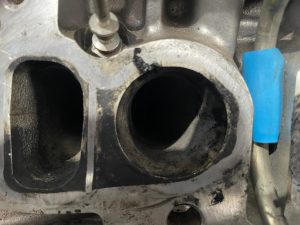
A closer look at the intake ports, showing less carbon buildup than in the heavily affected example
The process is the same whether you’re dealing with Tiguan intake valve carbon buildup or deposits on a Golf GTI or Golf R.
Why Trust Quality Car Service with VW Intake Valve Carbon Cleaning?
VW intake valve carbon buildup isn’t something that shows up during a routine service. Identifying it takes a thorough technical evaluation by a specialist who understands the VW TSI engine. Cleaning it requires the correct tooling and the experience to work on the intake manifold with confidence. The specialist you choose matters.
At Quality Car Service, Milton Keynes, our team works with VW owners across the area and has the experience and equipment to investigate performance issues on Golf GTI, Golf R, Tiguan, and other VW models. If carbon buildup is the cause, we have what’s needed to address it.
Here’s what you can expect when you choose Quality Car Service:
- Experienced VW technicians: Our team has hands-on experience with the TSI engine and the intake valve cleaning process.
- Courtesy car: A courtesy car is provided while your vehicle is in our care.
- 12-month parts and labour guarantee: Every repair we carry out is covered by a full 12-month warranty.
- Transparent pricing: You’ll know exactly what’s involved and what it costs before we begin any work.
Join {{review-count}} local customers across Milton Keynes who have left us a {{average-rating}} Google rating for excellent value, accurate repairs and honest communication.
Speak to our team at Quality Car Service on 01908 376555 to book your vehicle in for a thorough technical evaluation.
Frequently Asked Questions About VW Carbon Buildup
Can fuel additives prevent carbon buildup on VW engines?
Fuel additives help keep injectors and fuel lines in good condition, but they don’t come into direct contact with the intake valves on a direct-injection engine. Carbon deposits form on the valve surfaces where fuel doesn’t flow. Removing hardened carbon requires mechanical cleaning carried out by a technician with the appropriate equipment.
How do I know if my VW Golf has carbon buildup?
If you’ve been wondering, ‘why does my VW Golf run rough?’, VW Golf carbon buildup symptoms to watch for include an uneven idle before the engine warms up, a lag when you press the accelerator, and a general loss of the sharp throttle response the car was built for. Other faults can produce similar signs, so having a specialist carry out a full technical evaluation is the best way to pinpoint what’s behind it.
How much does VW intake valve carbon cleaning cost?
What it costs depends on how much carbon has accumulated and what work your particular vehicle needs. Our team at Quality Car Service, Milton Keynes is the smart alternative to the main VW dealer. Give us a call on 01908 376555, and we’ll walk you through what’s involved and what to expect.
How often does VW intake valve carbon buildup need cleaning?
There’s no fixed service schedule for intake valve carbon cleaning on a VW TSI engine. The rate at which deposits form depends on driving habits and maintenance history. Many owners first notice symptoms after tens of thousands of miles, but this varies from vehicle to vehicle. If something feels different about your engine’s performance, having a specialist who knows the VW TSI engine assess your vehicle is the best next step.