How Does Car Suspension Work?
You drive over a speed bump at the local retail park, and something thuds underneath the car. Nothing dramatic, just a dull thud you hadn’t noticed before.
Then you hit a pothole on the dual carriageway… same thing.
You turn the radio down, wait for it, and it comes back again on the next uneven stretch of road.
It’s the kind of noise you can chalk off as nothing, as there’s no warning light, no change in how the engine runs, nothing that stops you getting where you’re going.
But that thud could be a sign of suspension issues.
Suspension components wear over weeks and months, and because the changes are so gradual, it’s easy to miss them.
So what’s going on beneath the car? And when should you act on it?
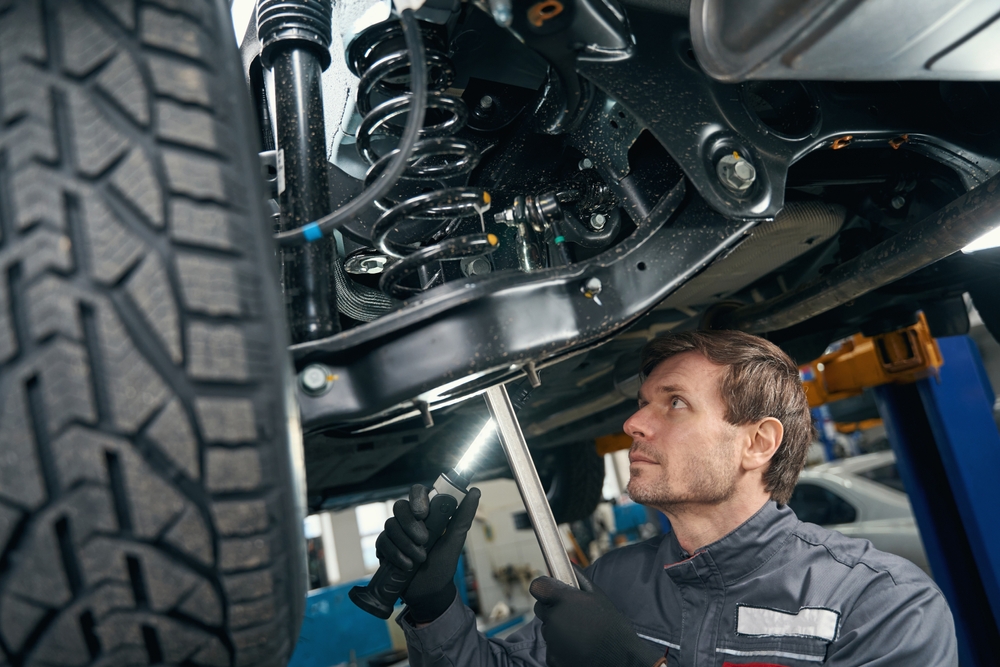
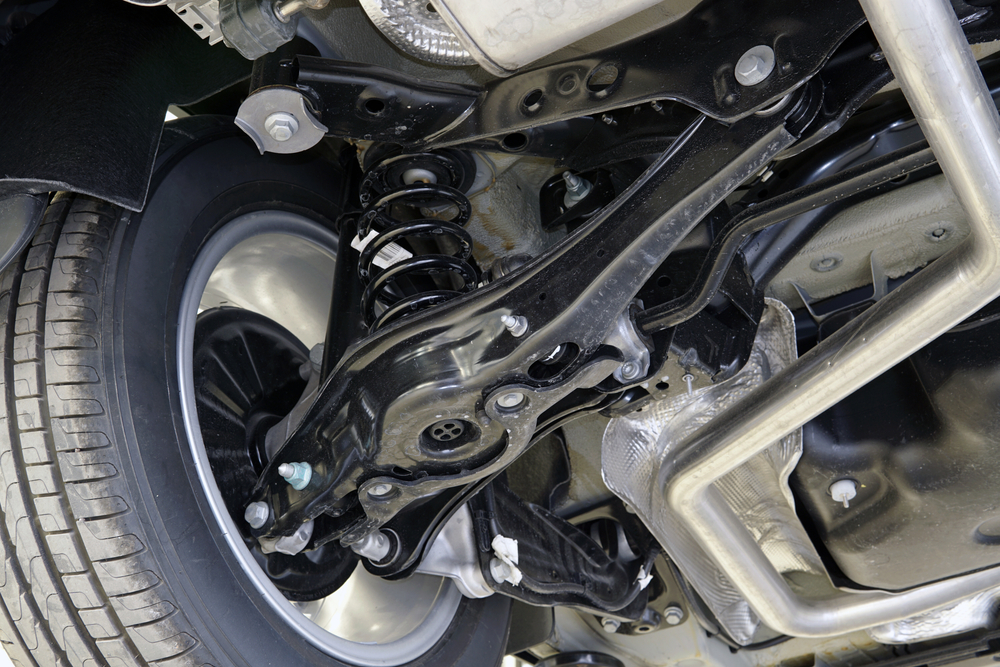
Your car’s suspension connects the wheels to the body and manages how the vehicle responds to uneven road surfaces, keeping the cabin steady and the tyres pressed to the ground. It includes springs, shock absorbers, control arms, and bushings, each of which wears at its own pace, meaning faults can develop without any sudden warning.
If you’ve ever asked, “How does car suspension work?”, this guide has the answers.
We’ll go through what each part does, how wear develops, and the symptoms to be aware of. Whether you’ve had an MOT advisory, noticed something different about how the car feels, or want to understand what’s happening before booking an appointment, this is a good place to start.
What Your Car’s Suspension Does
So, how does car suspension work? It starts with understanding what the system does each time you turn the key.
Every road surface has imperfections, such as potholes, expansion joints, and patches of worn tarmac. Without a suspension system, each of those would pass through the wheels of your car and into the cabin.
The suspension sits between the wheels and the body of the car. Its job is to manage how the vehicle responds to uneven road surfaces, keep the tyres in firm contact with the ground, and keep the cabin stable enough for you to steer, brake, and drive comfortably.
So what does car suspension do day to day? Three things simultaneously:
- Road Impact Control: When a wheel goes over a bump, the suspension compresses to absorb and reduce the force before it transfers into the vehicle.
- Tyre Contact: It maintains the tyres against the road surface, even over rough ground, so braking and steering stay effective.
- Stability: It manages how much the car rolls in corners, dips under braking, or settles at the rear when accelerating.
When the system is doing its job well, you don’t notice it. You won’t give it a thought until something starts to shift.
Once components begin to wear, the system loses its ability to manage those three tasks. That’s the point where it starts to show from behind the wheel.
How the Spring and Shock Absorber Pair Works
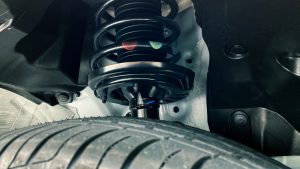
Multiple parts form your vehicle’s suspension system, but the heaviest demands fall on two: the spring and the shock absorber. Each has a distinct role, and they depend on one another to deliver a controlled ride. Once you see how this pair operates, the rest of the system slots into place.
Coil Springs: A steel coil spring is positioned at each corner of the vehicle. When the tyre encounters a pothole, a ridge, or a section of broken tarmac, the spring compresses to absorb that force and then pushes the wheel back to its resting height. That compression is what stands between the road surface and the cabin above.
Given enough miles, coil springs can lose their original height, develop fracture lines, or… fail outright.
A spring that’s dropped in height may leave the car sitting visibly lower on one corner. A fractured or collapsed spring is one of several parts capable of creating a knocking sound when driving over rough ground, and it’s a recognised MOT failure point.
Once the spring compresses, what brings the bouncing to a halt? The shock absorber handles that.
Shock Absorbers: Also called dampers, shock absorbers regulate the pace at which the spring settles back. Internally, oil passes through calibrated valve assemblies each time the suspension cycles up and down, converting that motion into heat and steadily dampening the oscillation. As they age, you may detect the car rocking after road imperfections, the bonnet dropping sharply under braking, or the body tilting through bends more than you’d expect.
A number of vehicles package both parts into one housing.
MacPherson Struts: Across a wide range of modern cars, the coil spring is mounted directly around the shock absorber body in a single integrated unit known as a strut. You’ll find this setup on most front-wheel-drive cars, though it’s common across many vehicle types. Because the strut also serves as a load-bearing element in the steering and suspension geometry, any repair or replacement involves the complete strut assembly rather than the spring or shock absorber individually.
Premium and performance vehicles often use a double-wishbone or multi-link layout instead, keeping the spring and shock absorber in separate locations to allow more precise tuning of how each wheel responds to the road.
If the car bounces more than it used to, feels less stable through bends, or dips sharply when you brake, the springs or shock absorbers are worth checking.
Our technicians at Quality Car Service, Milton Keynes, can assess these components and let you know what needs attention.
What Control Arms, Bushings, and Anti-Roll Bars Are There For
Springs and dampers handle the up-and-down movement, but your suspension also has to keep each wheel pointing in the right direction and sitting at the correct angle as you drive. That’s where control arms, bushings, and anti-roll bars come in.
Control Arms: Rigid metal arms connect each wheel hub to the car’s chassis or subframe. They give the wheel room to travel vertically while pinning its lateral and fore-aft position in place throughout the suspension’s range. When the rubber mountings or ball joints inside a control arm deteriorate, the wheel angle can wander, affecting steering feel, braking performance, and tyre lifespan.
Bushings: At every point where a control arm pivots against the body or wheel carrier, a rubber bushing sits between the two metal faces. Its role is to absorb vibration, reduce transmitted noise, and allow a defined range of joint movement.
When that rubber perishes, a hollow knocking sound when you drive over road imperfections, most apparent at lower speeds, is one of the earliest things drivers notice.
Your vehicle’s steering may also feel less direct, or the car may pull or drift to one side, though pulling can stem from other causes too, including tyre pressures, alignment, or brakes.
Anti-Roll Bars and Drop Links: A steel bar stretches from one side of the suspension to the other, resisting the car’s tendency to lean through corners. It connects to each suspension arm or strut via short rods called drop links.
Drop links wear at a steady rate and are a well-known MOT advisory item.
A deteriorating drop link can cause a rattle or tap over uneven road surfaces. Excessive free play in the ball joints, or a deteriorated dust cover that no longer keeps dirt out of the joint, can move a drop link from advisory into failure territory at MOT, depending on severity.
If you’re hearing knocking sounds when you drive over bumps, noticing tyres wearing unevenly, or the car doesn’t steer as crisply as it once did, control arms, bushings, or drop links could be among the causes.
Getting things checked sooner rather than later is worthwhile. Call Quality Car Service on 01908 376555, and we’ll talk you through what to do next.
Air Suspension: How It Differs and What Goes Wrong
Certain premium vehicles replace conventional coil springs with air suspension. Rather than a steel spring at each corner, inflatable suspension airbags take on the job of supporting the car and adjusting its ride height. Shock absorbers still provide the damping, just as they do in a conventional arrangement.
Height adjustments can occur without driver input depending on the configuration, in response to changes in speed, road conditions, or a selected driving mode. A compressor feeds pressurised air into the airbags, and electronic controls balance the pressure across all four corners to keep the car level.
The clearest indicator that something has gone wrong is the car settling lower on one side or dropping noticeably after standing overnight. In most cases, this traces back to a leak in one of the suspension airbags or a malfunction in the valve block that routes the airflow.
When an airbag leaks, the compressor has to run longer to maintain pressure, which can accelerate wear over time.
Air suspension repair requires expert knowledge and the correct equipment. The systems are electronically managed, the parts are vehicle-specific, and pinpointing the source of a leak takes experience.
If your car has air suspension and something doesn’t look or feel right, it’s worth having an expert assess it.
What Worn Suspension Feels Like Behind the Wheel
Suspension wear doesn’t announce itself overnight. It accumulates across weeks and months, and because you’re at the wheel day after day, adjusting to the gradual change without recognising it is natural.
So how does worn suspension reveal itself from the driver’s seat?
These are the signs of worn suspension that drivers pick up on:
- Clunking or Knocking: A strange knocking noise when you drive over potholes, speed bumps, or when turning at lower speeds. Worn bushings, drop links, a fractured spring, or other degraded parts can be responsible.
- Pulling to One Side: The car tracks left or right on its own. Several sources are possible, including worn control arms or bushings and altering the wheel angle. Although tyre pressures, alignment, or brakes may also play a part.
- Uneven Tyre Wear: Heavier wear on one edge of a tyre, or inconsistent patterns from left to right, can point to suspension deterioration, shifting the wheel geometry.
- Car Sitting Lower on One Corner: A visible tilt to one side signals a weakened or fractured spring, or on vehicles with air suspension, a slow leak.
- Excessive Body Roll: The car tilts noticeably through bends or lacks the planted feel it used to have at speed.
- Front End Dips Under Braking: The bonnet drops more sharply than expected when you apply the brakes. This can signal that the suspension is no longer distributing weight transfer effectively. Worn shock absorbers are one possible contributor.
These rank among the most recognised car suspension problems and symptoms, and they overlap more than you might expect. Multiple worn parts can contribute to a single sensation from the driver’s seat, which is why a full system assessment carries more weight than guessing at one component.
If any of this sounds familiar, get in touch with Quality Car Service, Milton Keynes, and we’ll check it over.
Your Suspension and the MOT
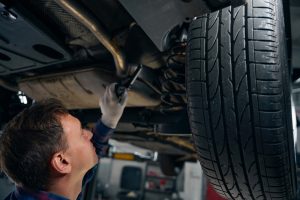
Every MOT includes a check of the suspension. Wear or deterioration that has progressed to the point of compromising safety or roadworthiness can result in an advisory or a failure.
Ball joints, springs, gaiters, bushings, drop links, and shock absorbers are among the items an MOT tester will examine. If the condition of any of these declines to a point that affects the vehicle’s roadworthiness, it is flagged.
In the UK, every vehicle over 3 years old must pass an MOT, which provides a single-day snapshot of the car’s condition. So, how long does car suspension last? That depends on driving habits, road conditions, mileage, and which specific parts are involved.
If you’ve noticed any car suspension problems or symptoms on a recent MOT advisory, it’s worth having them assessed before your next test.
Why a Specialist Should Assess Your Suspension
Different suspension faults can present in similar ways. A knocking sound when you drive over uneven road surfaces could trace back to a worn bushing, a drop link, or a fractured spring. Pulling to one side might sit with a control arm, a perished bushing, or something outside the suspension altogether.
Accurately identifying the faulty component before ordering parts matters.
Fitting the wrong one wastes money and leaves the underlying issue untouched. When multiple causes sit behind the same symptom, only a thorough assessment prevents unnecessary work.
A specialist examines the full suspension system. That means understanding how each part interacts with its neighbours, locating precisely where the wear sits, and explaining the findings before any work begins.
Now that “how does car suspension work?” has been answered and you understand what each part does and what wears out, you’re in a stronger position when you speak to a technician.
You’ll know what questions to ask, and you’ll understand what you’re being told.
Why Choose Quality Car Service, Milton Keynes, for Your Suspension?
Understanding your vehicle’s suspension system means you can recognise problems early and have a more informed conversation with your technician. To get everything checked, you need a garage that can assess the full system and get it right the first time.
Suspension wear tends to develop gradually, and when it’s caught early, many issues can be addressed before they progress, start affecting other components, or lead to an MOT failure.
At Quality Car Service, Milton Keynes, our technicians have the experience and equipment to assess your suspension to the required standard, identify what’s worn, and carry out any necessary work to a high standard.
By choosing Quality Car Service, you benefit from:
- Expert technicians focused on accurately identifying the problem the first time.
- All repairs backed by a 12-month parts-and-labour guarantee.
- A courtesy car is available while your vehicle is with us.
- Clear, upfront communication at every stage of the process.
Join {{review-count}} local Milton Keynes drivers who’ve rated us {{average-rating}} on Google, with reviews consistently praising the honesty of our assessments and the standard of our repairs.
Whether you’ve noticed a noise, had an MOT failure or advisory, or just want your vehicle’s suspension system checked, call Quality Car Service, Milton Keynes, on 01908 376555, and book an expert suspension inspection. We’ll check the full suspension system and let you know where things stand.
Frequently Asked Questions
How does car suspension work?
A collection of parts positioned between the wheels and the body governs how the car copes with imperfect road surfaces. Coil springs compress under force to cushion the initial impact of bumps and potholes; shock absorbers, also called dampers, then control how the spring recovers so the car settles rather than keeps oscillating. Control arms and rubber bushings anchor each wheel in position while giving it room to travel vertically. When every element is performing as intended, the result is a ride that feels composed, responsive, and comfortable.
What does car suspension do?
Your car’s suspension connects the wheels to the vehicle’s body, determining how the car reacts to whatever lies beneath the tyres. Tyre grip on the road, body stability through turns and during braking, and a ride quality that’s comfortable enough for daily driving are all within its scope. As parts within the system deteriorate, you may begin to detect shifts in steering response, ride comfort, or the way the car holds its composure.
What are the signs of worn suspension?
A hollow knocking sound when you drive over bumps and potholes, or when manoeuvring at low speed; the car veering or wandering without steering input; tyres wearing unevenly; the bodywork leaning to one side; and a pronounced tilt through corners are among the telltale indicators of suspension wear. Because these changes develop gradually, it’s worth booking an inspection if anything feels different to how the car once drove. Our experts at Quality Car Service can assess it for you.
How long does car suspension last?
There is no single answer, because each part in the system ages at its own rate and road conditions vary from one driver to the next. A car covering smooth motorway miles will wear its suspension differently from one running over patched urban roads day after day. Mileage, load, and driving style all feed into the picture. Booking a check around MOT time is a sensible way to stay ahead of wear before it progresses or begins affecting how the car handles.
Can worn suspension cause an MOT failure?
Yes, worn suspension can cause an MOT failure. Ball joints with excessive movement, fractured or sagging springs, torn gaiters, perished bushings, and worn drop links are all items an MOT tester will examine. If the deterioration has reached a level that affects roadworthiness, it results in a failure. Acting on any suspension advisory before the next test date is a practical step.